
Table of Contents
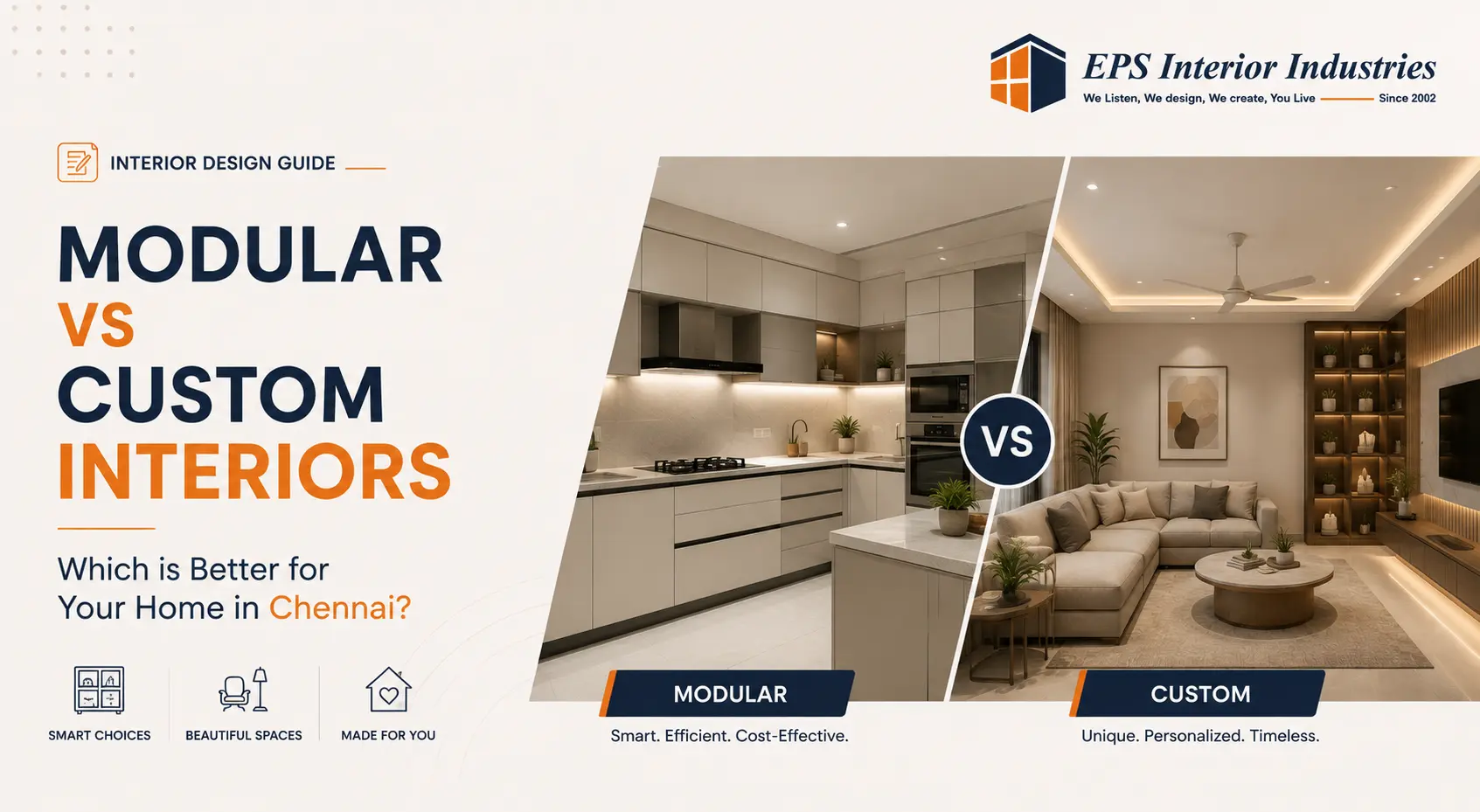
ToggleModular vs Custom Interiors: Which Is Better for Your Home in Chennai?
When planning the interiors of a new apartment, villa or independent house, one question comes up sooner or later: Should you choose modular interiors or go for custom-made furniture?
There is no universal winner.
A modular kitchen may be the more practical choice for one Chennai apartment, while a custom-built wardrobe or TV unit may make more sense in another home. Your decision depends on the available space, budget, design preferences, timeline, material specifications and how you expect to use the space.
The difference is also more nuanced than “factory-made versus carpenter-made.” A well-designed interior project may combine both approaches to get the advantages of each.
In this guide, let’s compare modular vs custom interiors based on design flexibility, cost, durability, maintenance, execution time and suitability for different types of Chennai homes.
What Are Modular Interiors?
Modular interiors use components that are designed and manufactured in a controlled factory environment and then transported to the site for installation.
Instead of building every cabinet from scratch at your home, the furniture is generally manufactured as individual modules according to the approved design and site measurements.
Common examples include:
- Modular kitchens
- Modular wardrobes
- TV units
- Storage cabinets
- Utility cabinets
- Shoe storage
- Study units
For example, a modular kitchen might be designed around your kitchen’s dimensions, appliance locations and storage requirements. The individual cabinet components are manufactured before being brought to the site, where they are assembled and installed.
Why do homeowners choose modular interiors?
The biggest attraction is predictability.
Because much of the manufacturing happens away from the home, the installation process can be relatively faster and cleaner than extensive site-based fabrication.
It can also provide greater consistency in dimensions, finishes and production quality when the manufacturer follows proper quality-control processes.
However, “modular” does not automatically mean high quality. The final result still depends on the board or core material, laminate or finish, edge treatment, hardware, manufacturing standards and installation quality.
What Are Custom Interiors?
Custom interiors are designed and built specifically around the requirements of a particular home and homeowner.
In traditional residential projects, this often involves site-based fabrication by carpenters, although custom furniture can also be manufactured in a workshop and tailored to the project.
Imagine an apartment with an unusually shaped wall, a column in the middle of a room or a sloping ceiling. Instead of adapting the room to standard cabinet dimensions, a custom solution can be designed around those constraints.
Custom interiors can include:
- Built-in wardrobes
- Bespoke TV units
- Custom storage
- Study tables
- Home libraries
- Feature walls
- Special-purpose furniture
- Customized bedroom furniture
The biggest advantage is design freedom.
You have greater control over dimensions, storage configuration, detailing, materials and appearance.
But that flexibility can also mean a longer execution period and greater dependence on workmanship and site supervision.
Modular vs Custom Interiors: Key Differences Explained
The right comparison isn’t simply “which one is better?” It is which one is better for your particular requirement?
Factor | Modular Interiors | Custom Interiors |
Design flexibility | High, but generally works within available modules and manufacturing capabilities | Very high; designed specifically for the space |
Execution time | Usually faster installation | Can take longer due to site fabrication |
Finish consistency | Generally more consistent when factory-controlled | Depends heavily on workmanship |
Customization | Good, particularly with experienced manufacturers | Excellent |
Unusual spaces | May require additional customization | Usually easier to adapt |
Cost | Depends on specifications and hardware | Depends heavily on materials and workmanship |
Maintenance | Individual modular components may be easier to replace | Repairs may require site work |
Quality control | More controlled during manufacturing | More dependent on site execution |
Best suited for | Fast, organized and predictable installations | Highly personalized or irregular requirements |
One important point: there is no automatic cost winner.
A premium modular kitchen can cost more than a basic carpenter-made kitchen, while a carefully specified custom interior can cost more than an entry-level modular solution.
The specifications matter more than the label.
Modular Kitchen vs Carpenter-Made Kitchen
The kitchen is where this decision becomes particularly important because it combines storage, appliances, plumbing, electrical points and frequent daily use.
Modular kitchen
A modular kitchen generally offers:
- Factory-manufactured components
- Consistent dimensions
- Faster installation
- A wide range of finishes
- Organized hardware integration
- Easier replacement of individual modules in some systems
Carpenter-made kitchen
A carpenter-made kitchen can offer:
- Greater on-site customization
- Flexibility around unusual walls and columns
- Tailored dimensions
- More freedom for certain design details
- On-site modifications during execution
But the quality can vary significantly depending on the carpenter, material specification and supervision.
For example, two kitchens may both be described as “plywood kitchens,” but their actual performance can differ because of the grade and thickness of the board, laminate, edge treatment, hinges, drawer channels and installation quality.
So when comparing a modular kitchen with carpenter work, don’t compare only the price. Compare the complete specification.
Advantages of Modular Interiors
1. Faster execution
Since many components are manufactured before reaching your home, site installation can be more streamlined.
This is particularly useful if you’re moving into a new apartment and have a strict possession or shifting deadline.
2. Consistent finish
Factory production can provide greater consistency in dimensions and finishing compared with extensive site fabrication.
3. Easier maintenance
A properly designed modular system can make certain repairs or replacements more straightforward because individual components can potentially be removed without rebuilding an entire unit.
4. Better process control
When design, manufacturing and installation are properly coordinated, homeowners get greater visibility into what is being produced and installed.
5. Cleaner installation
Reducing extensive cutting and fabrication inside the home can help minimize dust and disruption during installation.
Advantages of Custom Interiors
1. Maximum customization
If you have a very specific idea for your home, custom interiors provide more freedom.
You can specify the exact height, width, storage arrangement, finish and detailing.
2. Better adaptation to unusual spaces
Columns, beams, niches, awkward corners and irregular walls can be incorporated into the design instead of becoming wasted space.
3. Personalized aesthetics
A custom solution can be designed around your home’s architecture and your personal style rather than adapting your requirements to predefined modules.
4. Specialized storage
A homeowner who needs dedicated storage for books, collectibles, musical instruments, large appliances or other specific items can design the furniture around those requirements.
5. Unique furniture pieces
Custom fabrication makes sense when you want something that isn’t readily available as a standard modular configuration.
Which Option Is More Durable?
This is one of the biggest misconceptions in the modular-versus-custom debate.
Modular does not automatically mean more durable, and custom does not automatically mean stronger.
Durability depends on several factors:
Material quality
The core material such as plywood, MDF or particle board needs to be appropriate for the application.
Hardware
Hinges, drawer channels, handles and other hardware experience repeated use. Good hardware can make a significant difference to the everyday experience and longevity of furniture.
Workmanship
A high-quality material can still perform poorly if it is incorrectly installed or poorly finished.
Moisture exposure
This is particularly important in kitchens, utility areas and bathrooms. Material selection and edge protection need to reflect the environment.
Maintenance
Even good-quality furniture benefits from proper cleaning, avoiding prolonged water exposure and addressing hardware issues before they become larger problems.
So rather than asking “Is modular or custom more durable?”, ask:
What materials, hardware, construction method and warranty are included in the quotation?
That question will give you a much more useful answer.
Cost Comparison: Modular vs Custom Interiors in Chennai
There is no responsible single price for “modular interiors” or “custom interiors” because the cost can change substantially based on specifications.
For a Chennai home, the cost of a kitchen, wardrobe or complete interior may depend on:
- Size
- Material
- Finish
- Hardware
- Storage configuration
- Design complexity
- Brand specifications
- Installation
- Electrical modifications
- Plumbing requirements
- Accessories
- Project scope
Kitchen
A kitchen with basic cabinets and standard hardware will naturally have a different budget from one with premium finishes, advanced storage accessories, imported hardware or integrated appliances.
Wardrobes
A simple hinged wardrobe can have a very different cost from a full-height wardrobe with premium finishes, internal drawers, accessories and specialized storage.
Furniture
Custom TV units, study tables, crockery units and storage furniture vary significantly depending on dimensions, detailing and materials.
Look beyond the initial quotation
Suppose Vendor A quotes ₹X and Vendor B quotes ₹X + 20%.
That doesn’t necessarily mean Vendor A is cheaper.
If Vendor B includes better hardware, higher-grade materials, installation, warranty and additional storage accessories, the two quotations aren’t actually comparable.
Always compare the BOQ and material specifications not just the final number.
Which Is Better for Small Apartments?
For a compact apartment, space utilization should be the first priority.
A modular solution can work particularly well where the walls and dimensions are relatively regular and you want predictable installation.
For example, a 2BHK apartment might benefit from:
- Full-height wardrobes
- Modular kitchen storage
- Compact TV unit
- Foldable or extendable dining furniture
- Integrated study area
- Overhead storage
But custom furniture can be valuable when every centimetre matters.
Consider a bedroom with a structural column creating an awkward gap beside the wardrobe. A custom-designed unit could turn that otherwise unusable space into storage.
So for small apartments, the best approach may actually be a combination of modular and custom solutions.
Which Is Better for Luxury Homes & Villas?
Luxury homes and villas often have more architectural freedom, larger spaces and more personalized requirements.
This makes custom interiors particularly useful for:
- Large walk-in wardrobes
- Home libraries
- Feature walls
- Custom entertainment units
- Luxury kitchens
- Designer furniture
- Architectural detailing
- Special storage requirements
However, that doesn’t mean modular solutions have no place in luxury interiors.
A premium modular kitchen with carefully selected finishes and hardware can be an excellent choice for a high-end home.
The question is not whether a product is “modular” or “custom.” The more useful question is:
Does the solution deliver the design, finish, functionality and durability you expect?
Common Misconceptions About Modular Interiors
“Modular means low quality.”
Not necessarily.
Quality depends on the materials, manufacturing standards, hardware, installation and specifications. A well-engineered modular system can be highly durable.
“There is no customization in modular furniture.”
This is also misleading.
Many modular systems allow customization of dimensions, finishes, layouts and internal configurations. However, there are practical limits depending on the manufacturer’s system.
“Modular interiors are only for apartments.”
No.
Modular kitchens, wardrobes and storage systems can be used in apartments, villas and independent homes.
“Carpenter-made furniture is always cheaper.”
Not necessarily.
Custom furniture can involve premium materials, detailed workmanship, additional site labour and longer execution periods. The final price depends on the complete scope.
“Custom furniture is always better.”
Customization is valuable when you actually need it. If your requirement is straightforward, a well-designed modular solution may provide better process predictability and faster installation.
Best Interior Solution for Chennai Homes
Chennai’s coastal location and warm, humid conditions make material selection and moisture management important considerations for residential interiors.
This doesn’t mean there is one special “Chennai material” that works everywhere. Instead, the specification should reflect where the furniture is being installed and how the space is used.
Pay particular attention to kitchens and utility areas
These areas experience greater exposure to water, steam and cleaning activity.
Use appropriate moisture-resistant materials and ensure edges, joints and exposed surfaces are properly finished.
Think about ventilation
Good ventilation can help manage indoor moisture and improve comfort, particularly in kitchens and enclosed areas.
Choose finishes with maintenance in mind
Glossy finishes, textured surfaces, laminates and other materials can have different cleaning and maintenance requirements.
Consider long-term durability
For a Chennai home, don’t select materials purely because they look attractive in a showroom. Ask how they will perform under daily use, humidity, cleaning and temperature variations.
This is where professional material specification becomes valuable.
How to Decide Between Modular and Custom Interiors
Instead of choosing based on what is currently popular, use this checklist.
Choose more modular solutions if you:
- Have a strict completion deadline
- Prefer a clean, contemporary finish
- Have relatively standard room dimensions
- Want a more structured manufacturing process
- Prefer faster installation
- Need standardized storage systems
Consider more custom solutions if you:
- Have irregular spaces
- Need highly specialized storage
- Want unique furniture designs
- Have unusual architectural features
- Want extensive personalization
- Need furniture designed around specific lifestyle requirements
Consider a hybrid approach if you:
- Want a modular kitchen but custom living-room furniture
- Need modular wardrobes with custom storage
- Have both standard and irregular spaces
- Want to balance budget and customization
- Are designing a larger villa or independent house
For many Chennai homes, this hybrid approach can be more practical than choosing one system for the entire house.
Modular or Custom: Which One Should You Choose?
There isn’t a single answer to modular vs custom interiors.
If speed, process predictability and standardized manufacturing are your priorities, modular interiors can be an excellent choice.
If you need unusual dimensions, specialized storage or highly personalized furniture, custom interiors may be more appropriate.
And for many homeowners, the smartest solution is somewhere in between.
Use modular where standardization works. Use custom where personalization adds genuine value.
Most importantly, don’t choose your interiors based only on the lowest quotation or the appearance of a showroom display. Look at the materials, hardware, construction method, workmanship, warranty, project scope and long-term maintenance requirements.
For a Chennai home, that balanced approach can help you create interiors that aren’t just attractive on handover day, but remain functional and practical for years to come.
Ready to create a home that balances style, functionality, and personalization? Choose the right interior solution with EPS Interior Industries and bring your vision to life.
FAQs
Neither is automatically cheaper. The cost depends on material quality, hardware, design complexity, dimensions, finish and installation. Compare detailed specifications and BOQs rather than only the quoted total.
Yes, a well-designed modular system can be durable. Its lifespan depends on the core material, hardware, manufacturing quality, installation and maintenance.
Custom interiors can be particularly useful for villas because of larger spaces, unique architectural features and personalized requirements. However, premium modular systems can also work well.
It depends on your priorities. Modular kitchens generally offer more predictable manufacturing and faster installation, while carpenter-made kitchens can provide greater flexibility for unusual spaces and custom requirements.
Yes. A hybrid approach is often practical. For example, you could choose a modular kitchen and wardrobes while using custom-built furniture for the living room, study or entertainment area.
There is no universal answer. Material quality, hardware, workmanship, moisture protection and maintenance have a greater influence on durability than whether the furniture is modular or custom-made.

Vidya is a content writing specialist with over a decade of experience in the interior design industry. She collaborates with architects and interior designers to produce insightful, expert-driven content covering residential interiors, commercial spaces, and corporate office design, helping homeowners and businesses make informed decisions.
Related Blogs
Villa Interior Design in Chennai: Complete Guide for Luxury Homes
Home › Blog › Villa Interior Design Guide Villa Interior Design in Chennai: Complete Guide for Luxury Homes A villa gives you something an apartment…
Modular vs Custom Interiors | Which Is Better in Chennai?
Home › Blog › Modular Vs Custom Interiors Modular vs Custom Interiors: Which Is Better for Your Home in Chennai? When planning the interiors of…
Hybrid Office Design: Complete Guide to Planning a Flexible Workplace
Home › Blog › Hybrid Office Design Plan The traditional office was relatively simple: employees came to the same workplace, sat at assigned desks and…

Founded in 2002, EPS Interior Industries specializes in future-ready luxury designs for interior, exterior, and infrastructure needs. By leveraging our own Chennai-based manufacturing plant, we provide ISI-certified, factory-direct products that guarantee world-class quality at an affordable price point.
Contact Info
Address:
No. L10, SIDCO Guindy Industrial Estate,
Chennai - 600032
Phone:
+91 99405 40702 | +91 93637 33845