
Table of Contents
ToggleOffice Space Planning Guide: Best Layouts for Productivity & Efficiency
Designing an office isn’t just about placing desks and chairs it’s about shaping how people think, move, collaborate, and perform every single day. If your layout is working against your team, even the best talent will struggle. If it’s working with them, productivity feels natural.
Let’s break down how to plan an office space that actually improves efficiency not just looks good on paper.
What Does Office Space Planning Mean?
At its core, office space planning is the process of designing an office floor plan and workspace layout in a way that supports how your team works.
But in real-world execution, it goes far beyond that.
A well-planned office is flexible. A small workspace can be optimized into larger workstations. Workstations can be converted into a conference room when needed. Even individual desks can transform into interactive zones for collaboration.
Think of it like this:
- A poorly planned office → fixed layout, cluttered movement, constant interruptions
- An optimized office → adaptable spaces, smooth workflow, better focus
For example, imagine a team struggling in a cramped setup where meeting discussions happen at desks, causing noise and distractions. Now compare that to a layout with:
- Dedicated stand-up meeting zones
- Quiet focus areas
- Video conferencing spaces with noise control
Same team. Completely different output.
That’s the impact of a thoughtful office design strategy.
Importance of Office Space Planning for Productivity
Your office layout directly influences how your team works often in ways you don’t notice until productivity drops.
Here’s how:
1. Movement
If employees struggle to move around (tight walkways, blocked paths), it creates friction.
Small delays compound into lost hours.
2. Communication
An interactive workspace encourages quick discussions.
A poorly designed layout forces unnecessary meetings.
3. Focus
Noise-heavy environments without planning reduce deep work time.
Simple additions like telephone booths or quiet pods can dramatically improve focus.
4. Space Utilization
Overcrowded offices feel stressful. Underutilized spaces waste money.
Good planning balances both.
A common mistake?
Teams assume “more desks = more productivity.”
In reality, better layout = better output per employee.
Key Factors to Consider in Office Space Planning
Before jumping into an office floor plan design, you need clarity on these fundamentals:
- Space Availability
Not just total area but how usable it is after walkways, walls, and utilities. - Walkways & Movement Flow
Poor circulation leads to constant disruption. Movement should feel natural. - Lighting
Natural + artificial lighting impacts energy, mood, and productivity. - Sound Proofing & Noise Control
Essential for calls, meetings, and focused work. - Look & Brand Identity
Your office should reflect your company’s personality not just function. - Team Size
Avoid over- or under-planning capacity. - Department Needs
Sales teams need collaboration zones; developers need quiet areas. - Nature of Work
Focus-heavy vs communication-heavy teams require different layouts. - Future Scalability
Can your layout adapt when your team grows?
A strong plan balances today’s needs with tomorrow’s expansion.
Types of Office Floor Plan Layouts
There’s no one-size-fits-all layout. The right choice depends on how your team operates.
Open Office Floor Layout
An open workspace removes barriers between employees.
Features:
- Shared desks
- Minimal partitions
Pros:
- Encourages collaboration
- Better communication
Cons:
- Noise distractions
- Less privacy
Best for: Startups, creative teams, collaborative environments
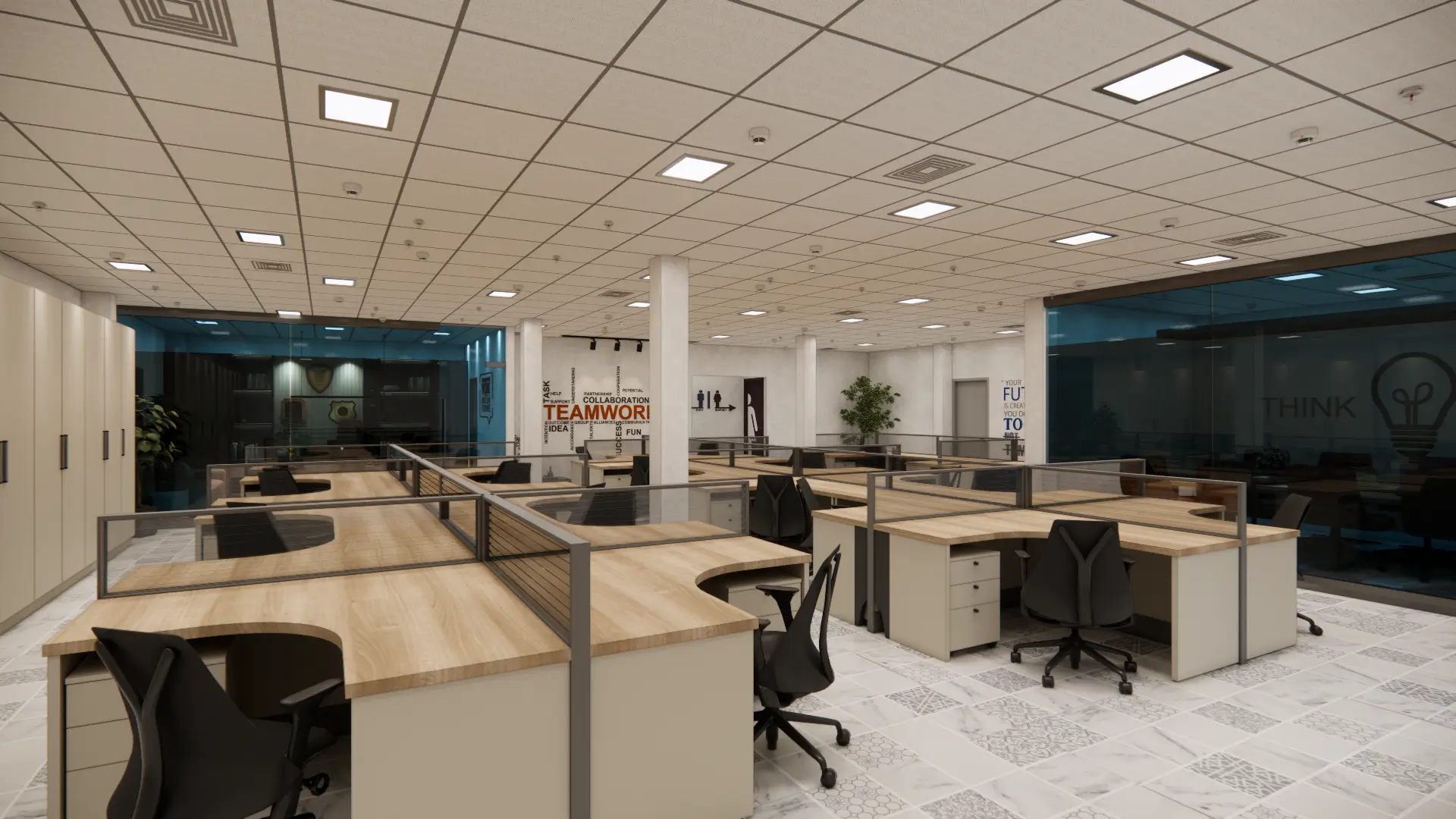
Cubicle Office Layout
A partition workspace with semi-private desks.
Features:
- Individual workstations
- Defined personal space
Pros:
- Better focus
- Reduced distractions
Cons:
- Less interaction
- Can feel restrictive
Best for: IT teams, finance roles, focus-driven work
Hybrid Office Layout
A mix of open workspace + private zones.
Features:
- Workstations + meeting rooms + quiet pods
Pros:
- Flexibility
- Supports multiple work styles
Cons:
- Requires careful planning
Best for: Most modern offices
Activity-Based Layout
Designed around task-based zones instead of fixed desks.
Features:
- Collaboration zones
- Focus rooms
- Breakout areas
Pros:
- Highly efficient
- Maximizes space usage
Cons:
- Needs disciplined usage
Best for: Large, dynamic teams
Expert Insight:
Modern offices are also integrating layouts like:
- Linear workstations
- Cabins for leadership
- Telephone booths for calls
- Pods for focused work
- Collective zones for teamwork
Office Space Planning Guidelines (Indian Standards & Best Practices)
When planning an office in India, many businesses either overestimate or underestimate space requirements. Following practical standards ensures your office floor plan design is both efficient and compliant.
Here are commonly recommended office space planning guidelines:
Recommended Space Standards
Area Type | Recommended Space (per person / unit) | Notes |
Workstation (Open Office) | 60–80 sq. ft. | Suitable for compact, collaborative teams |
Workstation (Cubicle) | 80–120 sq. ft. | Better for focused work environments |
Manager Cabin | 120–180 sq. ft. | Depends on furniture and meeting space inside |
Conference Room | 25–30 sq. ft. per person | Includes table, chairs, circulation |
Reception Area | 100–200 sq. ft. | Based on visitor frequency |
Breakout / Pantry | 50–75 sq. ft. per 10 employees | Can be multi-functional |
Walkways / Circulation | 25–30% of total space | Critical for smooth movement |
Telephone Booths / Pods | 15–25 sq. ft. per unit | For calls and focused work |
Recent global workplace studies indicate a steady reduction in office space per employee, with averages now approaching around 150 sq. ft. per person. This shift reflects the growing adoption of hybrid office work models, flexible seating, and collaborative layouts rather than large, fixed workstations. For Indian offices, this means space planning should focus less on rigid per-seat allocation and more on adaptable environments that balance density with comfort, productivity, and future scalability.
Best Practices to Follow
- Plan minimum 3–4 ft walkway clearance for easy movement
- Ensure natural light access wherever possible
- Allocate noise-controlled zones for calls and meetings
- Avoid overpacking desks leave room for flexibility
- Include future expansion buffer (10–20%)
Expert Insight:
Most offices fail not because of lack of space but because of poor allocation of circulation and functional zones.
How Much Office Space Do You Need?
This is one of the most important (and often miscalculated) decisions in office interior planning.
Standard Formula (Architectural Approach)
A commonly used formula in India:
Total Office Space = Number of Employees × Space per Employee + Circulation + Shared Spaces
Where:
- Space per employee = 60–120 sq. ft. (based on role)
- Add 25–30% for walkways
- Add space for meeting rooms, cabins, and amenities
Example 1: Small Office (10 Employees)
- Workstations: 10 × 70 sq. ft. = 700 sq. ft.
- Circulation (30%) = 210 sq. ft.
- Meeting + pantry = 200 sq. ft.
Total = ~1,100 sq. ft.
Example 2: Mid-Size Office (50 Employees)
- Workstations: 50 × 80 sq. ft. = 4,000 sq. ft.
- Circulation (25%) = 1,000 sq. ft.
- Conference rooms, cabins, breakout = 1,200 sq. ft.
Total = ~6,200 sq. ft.
What Most Businesses Miss
- They calculate only desks—not movement space
- They ignore future hiring
- They underestimate meeting and collaboration areas
The result?
An office that feels “full” within months.
A smarter approach is to design a scalable workspace layout from day one.
A Step-by-Step Guide to the Office Space Planning Process
A structured process ensures your office floor plan is not just visually appealing—but operationally efficient.
Step 1: Define Your Space Requirements
- Number of employees
- Departments
- Type of work (focus vs collaboration)
This sets the foundation for your entire layout.
Step 2: Create a Basic Layout Plan
- Allocate zones:
- Workstations
- Cabins
- Meeting rooms
- Breakout spaces
At this stage, think in terms of zones—not furniture.
Step 3: Plan Workflow & Movement
Ask:
- How do employees move daily?
- Where do interactions happen?
Ensure:
- Clear walkways
- Logical placement of teams
- Easy access to shared spaces
Step 4: Optimize for Productivity
Refine your workspace layout ideas:
- Add quiet zones for focus
- Create collaborative areas
- Include stand-up meeting spots
Balance:
Focus + Interaction + Flexibility
Step 5: Integrate Infrastructure
Plan for:
- Lighting
- Electrical points
- Internet & server areas
- Acoustic solutions
This prevents costly changes later.
Step 6: Visualize with 2D & 3D Plans
- 2D plans → structure
- 3D views → real-world clarity
This helps avoid design mistakes before execution.
Step 7: Execute with Flexibility in Mind
- Use modular furniture
- Allow convertible spaces
- Keep room for expansion
Step 8: Review & Optimize Post-Setup
Once the office is live:
- Observe movement issues
- Identify underused spaces
- Adjust layout if needed
Expert Insight:
The best office layouts are not “final.”
They evolve as your team and work style evolve.
Office Space Zoning and Workflow Planning
Instead of treating your office as one open area, divide it into functional zones.
Typical zones include:
- Reception
- Workstations
- Discussion rooms
- Conference hall
- Presentation hall
- Telephone booths
- Cafeteria / snack counter
- Waiting area
- Cabins
- Indoor relaxation zones
Why this matters:
- Reduces clutter
- Improves workflow
- Creates purpose-driven spaces
For example:
A team taking calls at their desks creates noise.
A simple telephone booth zone eliminates that problem entirely.
Workspace Layout Ideas for Small Offices
Small offices demand smarter—not smaller—thinking.
Here are practical workspace layout ideas:
- Linear Workstations
Align desks to maximize usable space. - Multi-functional Spaces
A single area can act as:- Waiting room
- Conference room
- Discussion space
- Convertible Cabins
Private cabins that can open up when needed. - Vertical Storage
Use walls instead of floor space. - Compact Furniture
Multi-use desks and foldable elements.
The goal is simple:
Make every square foot work twice.
Office Floor Plan Design Tips for Large Offices
Large offices introduce complexity—not just scale.
Here’s what changes:
- Department Zoning
Separate teams while maintaining connectivity. - Cubicles for Focus
Essential for structured work environments. - Multiple Conference Rooms
Small + large meeting spaces. - Larger Walkways
Prevent movement bottlenecks. - Enhanced Lighting
Maintain consistency across large areas. - Collaboration Zones
Encourage cross-team interaction.
Without proper planning, large offices quickly become inefficient and chaotic.
Common Office Space Planning Mistakes to Avoid
Here’s where most businesses go wrong:
Mistake | Impact | Solution |
Less moving space | Congestion, frustration | Plan wider walkways |
No breakout zones | Meetings disrupt work | Add discussion areas |
Poor soundproofing | Noise distractions | Use acoustic solutions |
No branding | Generic workspace | Reflect company identity |
Wrong chair/ergonomics | Health issues | Invest in ergonomic furniture |
Poor ventilation | Low energy, discomfort | Ensure airflow & fresh air |
Wrong door direction | Movement issues | Plan entry/exit flow |
These aren’t design flaws—they’re productivity killers.
Tools and Techniques for Office Floor Planning
You don’t need overly complex tools—but you do need clarity.
Common methods include:
- 2D Floor Plans
Basic layout structure and space allocation - 3D Visualization
Helps visualize real-world usage before execution - Layout Planning Tools
Used by designers to test different configurations
The goal isn’t fancy visuals—it’s better decision-making before execution.
Role of Interior Designers in Office Space Planning
A professional designer doesn’t just “design”—they prevent expensive mistakes.
Here’s what they bring:
- Expertise in layout optimization
- Efficient planning based on workflow
- Understanding of business requirements
- Space-saving techniques
- Avoiding costly errors in execution
They translate your business needs into a functional space.
If you’re exploring a structured approach, understanding the office interior design process and opting for turnkey office interiors Chennai can simplify execution significantly.
Office Space Planning Cost in Chennai
Costs depend on complexity, but here’s a realistic breakdown:
- Planning Charges:
Approx. ₹15 per sq. ft. - Design Fees:
Vary based on the interior design company and project scope
What influences cost?
- Office size
- Layout complexity
- Customization level
- Designer expertise
For a detailed breakdown, it’s worth exploring office interior cost per sq ft before finalizing.
Wrap Up
A well-designed office is not an expense—it’s an investment in productivity.
The right office space planning:
- Improves workflow
- Enhances employee efficiency
- Supports business growth
And more importantly—it reduces friction your team faces every day.
If you’re planning your workspace, consider getting expert guidance to avoid costly mistakes and create a layout that actually works.
Looking to design a high-performance office space? Get a consultation tailored to your business needs. Explore our commercial interior projects portfolio to know about our expertise, design & etc.
FAQs About Office Space Planning

Vidya is a content writing specialist with over a decade of experience in the interior design industry. She collaborates with architects and interior designers to produce insightful, expert-driven content covering residential interiors, commercial spaces, and corporate office design, helping homeowners and businesses make informed decisions.
Related Blogs
Transform Residential Space into Corporate Office Guide
Home › Blog › Convert House into Office – Guide Transform Residential Space into Corporate Office | Expert Guide for Chennai Businesses Converting a house,…
10 Modern Office Interior Design Ideas for Productive Spaces
Home › Blog › Modern Office Design Ideas 10 Modern Office Interior Design Ideas for Productive Spaces A modern office is no longer just a…
Acoustic Baffle Ceiling Design Ideas for Offices & Auditoriums
Home › Blog › Acoustic Baffle Ceiling Design Ideas Acoustic Baffle Ceiling Design Ideas for Offices & Auditoriums A ceiling does more than complete the…

Founded in 2002, EPS Interior Industries specializes in future-ready luxury designs for interior, exterior, and infrastructure needs. By leveraging our own Chennai-based manufacturing plant, we provide ISI-certified, factory-direct products that guarantee world-class quality at an affordable price point.
Contact Info
Address:
No. L10, SIDCO Guindy Industrial Estate,
Chennai - 600032
Phone:
+91 99405 40702 | +91 93637 33845