
Table of Contents
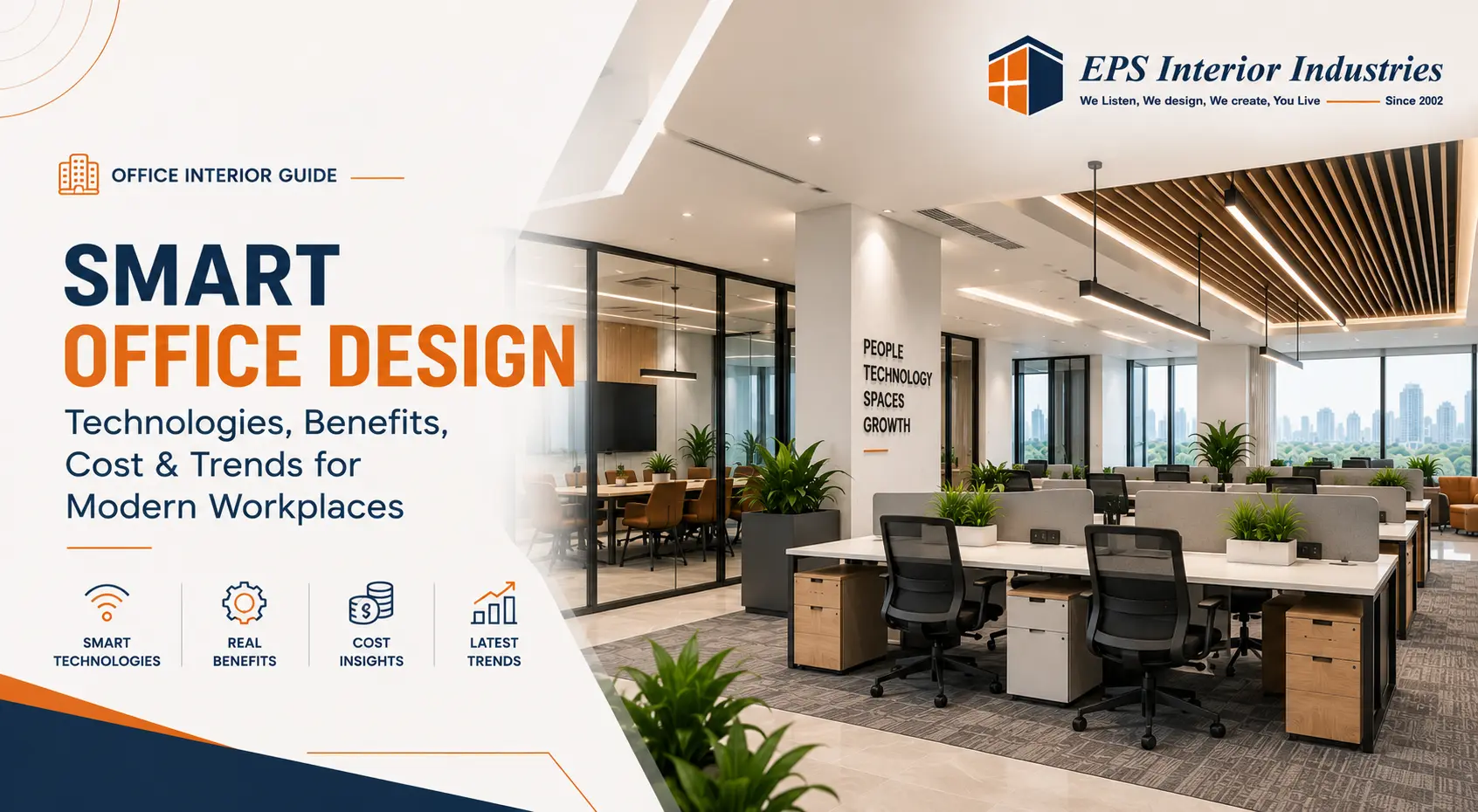
ToggleSmart Office Design: Technologies, Benefits, Cost & Trends for Modern Workplaces
Today’s workplace is no longer just a collection of desks, cabins and meeting rooms. Businesses are increasingly designing offices around how people actually work how teams collaborate, how meeting rooms are used, how much energy the building consumes and how easily employees can move between different work settings.
This is where smart office design comes in.
A smart office combines thoughtful interior planning with technologies such as smart lighting, occupancy sensors, intelligent HVAC controls, access control, connected meeting rooms, IoT devices and workplace analytics. The objective is not to fill an office with gadgets. It is to create a workplace where technology quietly solves everyday problems while supporting employee comfort, operational efficiency and future business needs.
The shift is also visible in India’s corporate real estate market. CBRE’s 2026 India Office Occupier Survey, based on responses from more than 200 CXOs, found that 93% of occupiers reported some stage of AI adoption, while 67% expected flexible workspaces to form part of their office portfolio within two years.
For businesses planning a new office or renovating an existing office, this makes smart office planning worth considering from the beginning not as an expensive technology layer added after construction.
What Is Smart Office Design?
Smart office design is the integration of office interiors, workplace planning, building systems and digital technologies to create a more connected and responsive workplace.
A traditional office typically depends on manual controls and fixed layouts:
- Lights are switched on and off manually
- Meeting rooms are booked manually
- Air-conditioning operates on fixed schedules
- Employees may have permanently assigned desks
- Facility managers have limited information about space usage
- Security systems often operate independently
A smart workplace connects these functions through sensors, software and automation.
For example:
Traditional Office
Manual switches → Manual room booking → Fixed AC schedules → Fixed workstations → Limited usage data
Smart Office
Occupancy sensors → Automated lighting → Digital room booking → Energy monitoring → Workplace analytics
The important distinction is that smart office design is not simply office automation.
It combines technology with space planning.
For example, an occupancy sensor becomes useful when its data helps a facility team understand whether a meeting room, workstation zone or collaboration area is being underused. Similarly, smart lighting becomes more valuable when lighting zones are planned around daylight, occupancy and the activities taking place in each area.
JLL describes this broader shift as the convergence of IoT and AI in workplace and facility management, with applications including predictive maintenance, energy optimisation, space utilisation and personalised workplace environments.
Why Are Modern Businesses Investing in Smart Office Design?
The business case for a smart office is broader than reducing electricity consumption.
Better workplace productivity
Employees spend time moving between meetings, workstations, collaboration areas and virtual calls. Technology can remove some of the friction involved in these activities.
For example, digital meeting-room booking can reduce room conflicts, while occupancy analytics can help organisations understand whether their workspace actually matches employee behaviour.
Gensler’s 2025 Global Workplace Survey of 16,809 full-time office workers across 15 countries found that employees with greater choice in where and how they work were 2.5 times more likely to say their workplace supports individual and team productivity.
Reduced operating costs
Automated lighting, occupancy-based HVAC and energy monitoring can help reduce unnecessary operation of building systems.
However, the actual savings depend on the building, equipment, occupancy patterns, controls and how the system is operated. Smart technology should therefore be treated as an energy-management tool, not as a guaranteed percentage saving.
Better employee wellbeing
Temperature, lighting, air quality, acoustics and workplace choice all influence the office experience.
Research involving office workers in six countries, including India, found associations between higher indoor PM2.5 and CO₂ levels and slower or less accurate performance on several cognitive tests.
This is why indoor air-quality monitoring can be more than a technology feature—it can become part of a broader workplace wellbeing strategy.
Hybrid-work readiness
Modern offices increasingly need to support both in-person and virtual collaboration.
Smart meeting rooms, video conferencing, room booking and flexible workstations can make hybrid work easier to manage.
Stronger company image
A well-designed smart reception, digital signage, automated meeting rooms and technology-enabled collaboration areas can communicate that a company is modern and professionally managed.
Better visitor experience
Digital visitor management, QR-based check-in, access control and reception technology can streamline the visitor journey while maintaining security.
Future scalability
Technology requirements change quickly. Designing the infrastructure correctly from the beginning makes it easier to add new devices, sensors and systems later.
Essential Smart Office Technologies Every Modern Workplace Should Have
Not every business needs every smart technology.
The right approach is to identify workplace problems first and then select technology that solves them.
Smart Lighting Systems
Smart lighting can combine:
- Motion sensors
- Occupancy sensors
- Daylight sensors
- Automated schedules
- Dimmable LED fixtures
- Centralised lighting controls
For example, lights in a meeting room can respond to occupancy rather than remaining switched on throughout the day.
Daylight sensors can also help regulate artificial lighting in areas with sufficient natural light.
The benefits can include:
- Better lighting control
- Reduced unnecessary energy use
- More consistent visual comfort
- Easier facility management
- Reduced manual intervention
Lighting should still be planned around the task being performed. A smart control system cannot compensate for an incorrectly designed lighting layout.
Intelligent HVAC and Climate Control
HVAC is one of the most important systems in an office, particularly in Chennai’s warm and humid climate.
Smart HVAC systems can integrate:
- Temperature sensors
- Occupancy information
- Zone-based cooling
- Humidity monitoring
- Indoor air-quality sensors
- Automated schedules
- Building Management System integration
Instead of treating the entire office as one thermal zone, different areas can be managed according to occupancy and usage.
A meeting room occupied by 12 people may have very different cooling requirements from a small cabin occupied by one person.
Indoor environmental quality also has a direct relationship with workplace performance. Research published through PubMed has found that temperature and illumination can influence office-worker performance, while other studies have linked indoor air quality and ventilation conditions with cognitive performance.
Smart Meeting Rooms
Meeting rooms have become one of the most technology-dependent spaces in a modern office.
A smart meeting room can include:
- Wireless presentation
- Microsoft Teams Rooms
- Zoom Rooms
- Interactive displays
- Digital whiteboards
- Video conferencing
- Room-booking panels
- Occupancy detection
- Meeting-room analytics
- AI-supported meeting assistants
The design challenge is not simply installing a large display.
Camera position, acoustics, lighting, power, networking, screen visibility and furniture arrangement all need to work together.
This is particularly important for hybrid meetings, where poor camera angles or room acoustics can make remote participants feel disconnected.
JLL’s workplace research also identifies enhanced conference-room technology and occupancy technology as important components of workplaces adapting to hybrid work.
Smart Access Control Systems
Modern offices can use different forms of access control depending on their security requirements:
- RFID cards
- Biometric authentication
- Mobile credentials
- Facial recognition
- Smart locks
- Visitor management systems
These systems can help organisations control who enters specific areas and create digital records of access.
For sensitive workplaces, access can also be segmented—for example, general employees may access work areas while server rooms, management areas and other restricted zones require additional authentication.
Any biometric or facial-recognition system should be implemented with appropriate privacy, data-security and legal considerations.
IoT Sensors for Workplace Analytics
Internet of Things, or IoT, devices allow physical spaces to generate useful data.
Examples include sensors measuring:
- Occupancy
- Desk utilisation
- Meeting-room usage
- Temperature
- Humidity
- CO₂
- Indoor air quality
- Equipment status
This data can help facility managers answer practical questions:
Are meeting rooms actually being used?
Which work areas remain empty most of the day?
Which zones become uncomfortable during peak occupancy?
Does the office need more collaboration space or more individual work areas?
JLL notes that sensors, beacons and smart-building systems can provide data about how people use workplace areas, supporting more evidence-based space planning.
Smart Office Automation
Office automation can bring multiple building functions together.
Depending on the project, automation may cover:
- Lighting
- Blinds
- Curtains
- Power control
- HVAC
- Conference rooms
- Scheduling
- Digital signage
- Security
- Centralised dashboards
For example, a “meeting mode” could potentially activate the required lighting, display and room settings from one control interface.
The goal should be useful automation, not automation for its own sake.
AI-Powered Office Solutions
AI is becoming another layer within smart workplace systems.
Potential applications include:
- AI reception assistants
- Virtual workplace assistants
- Meeting transcription
- Visitor kiosks
- Predictive maintenance
- Energy optimisation
- Workplace analytics
- Space-utilisation analysis
The most useful applications are those connected to a real business problem.
For example, AI-based analytics can help identify patterns in workplace utilisation, while predictive maintenance can use equipment data to identify potential issues before they become major failures.
JLL’s 2025 research on India’s smart offices highlights the growing combination of IoT and AI for predictive maintenance, energy optimisation, space utilisation and workplace personalisation.
Smart Security and Surveillance
A smart office security system can integrate:
- CCTV
- Motion detection
- Access control
- Smoke detection
- Fire alarms
- Emergency notifications
- Centralised monitoring
AI-enabled CCTV may also provide features such as object detection or unusual-activity alerts, depending on the system.
However, surveillance should be designed alongside privacy policies, cybersecurity controls and appropriate access permissions.
A technologically advanced security system is only useful if the underlying network, storage and maintenance processes are properly managed.
Smart Furniture That Enhances Workplace Productivity
Technology should not stop at the ceiling and walls.
Furniture can also become part of the smart workplace.
Examples include:
- Height-adjustable desks
- Sit-stand workstations
- Wireless charging desks
- Acoustic phone booths
- Acoustic pods
- Collaborative furniture
- Modular workstations
- Smart storage
- Ergonomic seating
The important point is to plan furniture and technology together.
For example, if every workstation requires power and data connectivity, the furniture layout should be coordinated with electrical and networking plans before installation.
Similarly, phone booths and acoustic pods should be located where employees actually need quiet spaces—not simply because they are popular workplace products.
Designing a Smart Office Layout
Technology works best when the physical office is designed around different types of work.
A modern office may include:
- Activity-based working zones
- Open collaboration areas
- Focus rooms
- Breakout spaces
- Phone booths
- Hybrid workstations
- Hot-desking zones
- Flexible seating
- Storage areas
- Informal meeting spaces
The layout should also provide a natural movement flow between these spaces.
For example:
Reception → Visitor meeting rooms
Workstations → Collaboration zones
Workstations → Focus rooms
Pantry → Breakout area
Technology can then support each zone.
Occupancy sensors can monitor usage, smart lighting can respond to presence, room-booking systems can manage meeting spaces and environmental sensors can monitor comfort.
This data can eventually inform future office planning.
Gensler’s 2025 global workplace research found that workers increasingly value choice and flexibility, with private areas, flexible environments and control over factors such as lighting and noise contributing to better workplace experiences.
Best Smart Office Technologies by Office Area
Office Area | Recommended Smart Technologies |
Reception | Digital visitor management, digital signage, AI reception |
Workstations | Occupancy sensors, sit-stand desks, smart lighting |
Meeting Rooms | Smart displays, video conferencing, room booking |
CEO/Executive Cabin | Smart lighting, automated blinds, environmental controls |
Cafeteria | Smart lighting, digital ordering where relevant |
Washrooms | Sensor faucets, occupancy sensors |
Parking | Smart parking systems, access control |
Server Room | Temperature and environmental monitoring |
Security Areas | CCTV, access control and monitoring |
Collaboration Areas | Occupancy sensing, wireless presentation |
Focus Rooms | Room booking, occupancy detection, acoustic planning |
The right combination depends on the business, building and budget. A 30-person startup does not necessarily need the same technology stack as a 500-person enterprise office.
Benefits of Smart Office Design
Improved Productivity
Smart technologies can reduce repetitive manual processes and make workplace resources easier to access.
Digital room booking, automated environmental controls and workplace analytics are examples of technology supporting employees rather than distracting them.
Lower Energy Consumption
Occupancy-based lighting, HVAC controls and energy monitoring can reduce unnecessary operation.
The actual benefit depends on occupancy patterns, equipment efficiency, control strategy and building characteristics.
Better Employee Experience
Comfortable lighting, appropriate temperature, good air quality, flexible work settings and easy access to technology can contribute to a better workplace experience.
Increased Workplace Safety
Integrated access control, CCTV, emergency systems and environmental monitoring can provide facility teams with better visibility of the workplace.
Space Optimisation
Occupancy data can show how frequently different areas are actually used.
Instead of guessing whether an office needs another meeting room, organisations can use utilisation data as one input into the decision.
Future Scalability
A well-designed smart office infrastructure can make it easier to introduce new systems as business requirements change.
This is particularly relevant as AI and workplace technology continue to evolve. CBRE’s 2026 India Office Occupier Survey found that 93% of surveyed occupiers reported some stage of AI adoption, showing how quickly AI is becoming part of broader business strategy.
Challenges of Implementing Smart Office Technologies
Smart offices offer significant possibilities, but implementation needs careful planning.
Problem | Cause | Practical Solution |
High initial investment | Multiple systems installed at once | Use phased implementation |
Technology integration issues | Independent systems cannot communicate | Define integration requirements early |
Poor network infrastructure | Insufficient bandwidth/cabling | Upgrade the IT backbone |
Cybersecurity risks | Connected devices create additional endpoints | Secure networks, devices and access |
Employee adoption | Employees don’t understand new systems | Provide training and onboarding |
Vendor compatibility | Proprietary systems may not integrate | Prioritise interoperable technologies |
Maintenance complexity | More connected equipment | Plan maintenance access and ownership |
Data/privacy concerns | Collection of occupancy or access data | Establish clear data governance |
The smartest office is not necessarily the one with the most technology.
It is the one where each technology has a clear purpose.
Smart Office Design Cost in Chennai
There is no reliable universal price for a smart office because technology can range from basic automation to a highly integrated workplace platform.
The total investment depends on:
- Office size
- Number of employees
- Automation level
- Electrical infrastructure
- Networking requirements
- Smart lighting
- HVAC controls
- Meeting-room technology
- Access control
- CCTV
- Sensors
- Furniture
- Software platforms
- Integration requirements
- Installation
- Testing and commissioning
- Maintenance requirements
A basic smart office may focus on lighting, room booking and access control, while a larger corporate project may integrate HVAC, BMS, IoT sensors, analytics, security and energy-management systems.
Plan technology before interiors
One of the biggest cost-control opportunities is planning technology during the design stage.
If networking, sensors, displays, access control and smart lighting are considered after the ceiling, partitions and furniture are completed, retrofitting can involve additional cabling, drilling and rework.
For larger projects, technology requirements should therefore be coordinated alongside:
Space planning → Electrical → HVAC → Ceiling → Networking → Furniture → AV → Automation
This approach reduces the risk of treating technology as an afterthought.
Latest Smart Office Design Trends in 2026
Smart office technology is moving beyond simple automation toward more responsive and data-driven workplaces.
AI-enabled workplaces
AI is increasingly being integrated into workplace analytics, meeting tools, facility management and operational systems.
CBRE’s 2026 India Office Occupier Survey found that 93% of surveyed occupiers reported some stage of AI adoption.
Touchless offices
Sensor-based faucets, doors, access systems and other touchless technologies can improve convenience and hygiene in appropriate areas.
Occupancy analytics
Occupancy sensors can help organisations understand actual workspace utilisation and support decisions around desks, meeting rooms and collaboration areas.
Smart wellness spaces
Wellness rooms, quiet spaces, better air-quality monitoring and environmental controls are becoming part of broader workplace experience strategies.
Phone booths and acoustic privacy
As offices support more virtual calls and focused work, small acoustic rooms and phone booths can provide alternatives to open workstations.
Digital twins
Digital twins and advanced 3D models can help organisations understand building and space data. JLL notes that BIM, digital twins and AI-enabled models can support design testing, maintenance tracking and space utilisation.
Wireless workplaces
Wireless presentation, charging and connected devices can reduce dependence on visible cabling, although critical infrastructure still needs properly planned wired networks.
IoT-enabled furniture
Desks, meeting furniture and workplace devices are increasingly capable of generating data or integrating with workplace platforms.
Energy-efficient offices
Energy monitoring, smart controls, efficient lighting and HVAC optimisation are becoming increasingly important as businesses focus on operating costs and sustainability.
CBRE’s 2026 India office research also highlights growing attention to sustainability and long-term workplace strategy, while its 2026 ESG research discusses smart energy design and efficiency interventions for Indian offices.
Hybrid collaboration spaces
Meeting rooms increasingly need to support people in the room and participants joining remotely.
Biophilic smart offices
Natural light, greenery and comfortable environmental conditions can be combined with smart controls rather than treated as separate design elements.
Acoustic privacy solutions
Smart offices still need good acoustics. Technology cannot compensate for a poorly planned acoustic environment.
Common Smart Office Design Mistakes to Avoid
1. Buying gadgets before planning
Technology should follow workplace requirements, not the other way around.
2. Ignoring electrical capacity
Smart devices still require reliable electrical infrastructure.
3. Poor cable management
A smart office with exposed cables and improvised wiring does not create a seamless technology experience.
4. No maintenance access
Sensors, controllers, network equipment and HVAC components eventually require servicing.
5. Insufficient Wi-Fi coverage
Meeting rooms, collaboration zones and high-density work areas may have different connectivity requirements.
6. Ignoring cybersecurity
Every connected device should be considered part of the wider technology environment.
7. Over-automation
Not everything needs to be automated.
Sometimes a simple manual control is more reliable and easier to maintain.
8. Poor lighting planning
Smart controls cannot fix an incorrectly designed lighting layout.
9. Lack of scalability
Don’t design the infrastructure only for today’s employee count.
10. Technology without employee training
Even well-designed systems fail when employees don’t know how to use them.
How to Plan a Smart Office Project
A structured office planning process can prevent expensive changes later.
1. Understand business objectives
Define what the smart office should actually improve energy management, collaboration, security, employee experience, space utilisation or a combination.
2. Assess employee needs
Understand how employees work and how often they use meeting rooms, focus spaces and collaborative areas.
3. Define technology requirements
Create a technology list based on actual business needs.
4. Prepare the budget
Separate interior, infrastructure, technology, installation and ongoing maintenance costs.
5. Design the office layout
Create zones for focused work, collaboration, meetings, social interaction and support functions.
6. Plan networking infrastructure
Design structured cabling, Wi-Fi, racks and connectivity before interior execution.
7. Select compatible technologies
Check whether lighting, HVAC, room booking, access control and analytics systems can communicate where integration is required.
8. Execute the interiors
Coordinate civil work, partitions, ceiling, electrical, HVAC, lighting, furniture and technology installation.
9. Test automation systems
Test sensors, room booking, access control, lighting, HVAC controls, AV and other connected systems.
10. Train employees
Employees should understand how to book rooms, use meeting technology and interact with new workplace systems.
11. Monitor and optimise
The project should not end at handover. Usage data can reveal where the office needs further adjustment.
Final Thoughts
A smart office is more than a collection of connected devices.
It is a workplace where interior design, technology, infrastructure and human needs work together.
The most useful smart office may have automated lighting, occupancy sensors, intelligent HVAC, connected meeting rooms, access control and workplace analytics. But those technologies only create value when they solve genuine workplace problems.
For a new office, the opportunity is to build the technology infrastructure into the design from day one. For an existing office, the better approach may be to identify the biggest operational gaps and introduce smart technologies in phases.
The workplace itself is also changing. Current research shows growing interest in flexible workspaces, technology-enabled offices, AI adoption and workplace environments that provide employees with greater choice and better experiences.
For businesses in Chennai, this means smart office design should be approached as a long-term workplace investment rather than a collection of fashionable technologies.
Plan the space first. Understand the people. Define the problems. Then choose the technology.
That is what turns a technology-enabled office into a genuinely smart workplace.
FAQs
A smart office combines workplace design with connected technologies such as sensors, automation, smart lighting, intelligent HVAC, access control, meeting-room technology and analytics.
Common technologies include IoT sensors, occupancy detection, smart lighting, HVAC controls, access control, CCTV, room-booking systems, video conferencing, workplace analytics and energy-management systems.
It can require a higher initial investment than a basic office, depending on the technology scope. However, smart features can be introduced in phases rather than implemented all at once.
Yes. Existing offices can often be upgraded with selected technologies. The first step should be assessing the electrical system, networking infrastructure, HVAC, ceiling access and existing building systems.
There is no single percentage that applies to every smart office. Savings depend on the building, equipment, occupancy, control strategy and operating practices. Energy performance should be measured against the property's actual baseline.
Technology companies, corporate offices, GCCs, professional services firms, startups, large enterprises and businesses operating hybrid workplaces can benefit from smart workplace systems. The right solution depends on the organisation's requirements.
ROI can come from several areas, including energy management, space optimisation, reduced manual processes, improved meeting-room utilisation and employee experience. A proper business case should quantify the benefits relevant to the specific workplace.
The timeline depends on the office size, technology scope, infrastructure condition and integration requirements. Technology should ideally be coordinated with the interior project from the design stage rather than added after completion.

Vidya is a content writing specialist with over a decade of experience in the interior design industry. She collaborates with architects and interior designers to produce insightful, expert-driven content covering residential interiors, commercial spaces, and corporate office design, helping homeowners and businesses make informed decisions.
Related Office Interior Design Blogs
Smart Office Interior Design | Technologies Every Modern Office Should…
Home › Blog › Smart Office Interior Design – Guide Smart Office Design: Technologies, Benefits, Cost & Trends for Modern Workplaces Today’s workplace is no…
Transform Residential Space into Corporate Office Guide
Home › Blog › Convert House into Office – Guide Transform Residential Space into Corporate Office | Expert Guide for Chennai Businesses Converting a house,…
10 Modern Office Interior Design Ideas for Productive Spaces
Home › Blog › Modern Office Design Ideas 10 Modern Office Interior Design Ideas for Productive Spaces A modern office is no longer just a…

Founded in 2002, EPS Interior Industries specializes in future-ready luxury designs for interior, exterior, and infrastructure needs. By leveraging our own Chennai-based manufacturing plant, we provide ISI-certified, factory-direct products that guarantee world-class quality at an affordable price point.
Contact Info
Address:
No. L10, SIDCO Guindy Industrial Estate,
Chennai - 600032
Phone:
+91 99405 40702 | +91 93637 33845